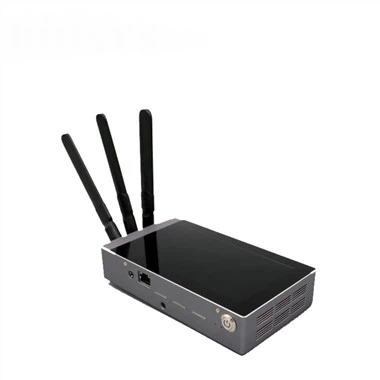
4K UHD HEVC Encoding Systems With 4G Integration Redefine Live Production Standards
Apr 08, 2025
Market Dynamics: Convergence of Bandwidth Efficiency and Ultra-High Definition
The global broadcast and streaming equipment market is undergoing a transformative phase, driven by the escalating demand for 4K UHD HEVC (H.265) encoding systems integrated with 4G/LTE transmission capabilities. According to ABI Research, the sector is projected to grow at 14.6% CAGR through 2030, fueled by:
Live Sports and Event Production: 78% of Tier 1 broadcasters now mandate sub-2-second latency for 4K HDR remote productions.
Hybrid 4G+5G Workflows: Temporary 4G bonding solutions bridging 5G infrastructure gaps in emerging markets.
Regulatory Shifts: FCC and ITU-R mandates for HEVC adoption in public service broadcasting to reduce satellite bandwidth costs by 30–40%.
Technical Innovations Driving Procurement Decisions
1. HEVC Encoding Breakthroughs
Bitrate Optimization: Adaptive quantization algorithms achieving 4K60p streaming at ≤25 Mbps with 10-bit color depth, meeting Netflix VMAF ≥90 benchmarks.
Low-Latency Modes: Frame-level parallel processing enabling 800 ms end-to-end latency for live news and eSports.
Hybrid Log-Gamma (HLG) Support: Real-time HDR-to-SDR conversion for backward compatibility with legacy 4G networks.
2. 4G Transmission Enhancements
Multi-Carrier Aggregation: Bonding up to 8 LTE channels for aggregate throughputs of 400 Mbps, suitable for dual 4K HDR feeds.
AI-Powered Network Switching: Predictive algorithms selecting optimal base stations based on SNR (≥15 dB threshold) and packet loss (<0.5%).
MIMO Antenna Integration: 4×4 MIMO configurations maintaining 4K stability at vehicular speeds up to 120 km/h.
3. Operational Resilience Features
Power-over-4G (Po4G): Solar/battery hybrid units supporting 12-hour continuous operation for field journalism.
IP67 Ruggedization: Military-grade shock/vibration resistance (MIL-STD-810H) for disaster response deployments.
Strategic Procurement Considerations
1. Performance Benchmarking
Validate 4:2:2 chroma subsampling capabilities for broadcast-grade color accuracy.
Require AES-256 encryption and HDCP 2.3 compliance for premium content protection.
2. Standards Compliance
Mandatory Certifications:
DVB-T2/T2-Lite for terrestrial broadcasting
3GPP Release 15 LTE-Advanced Pro
SMPTE ST 2110-20 for IP-based workflows
3. Total Cost of Ownership (TCO) Optimization
Hardware Lifespan: ≥50,000 operating hours for ASIC-based HEVC encoders.
Energy Efficiency: ≤45 W power draw for 4Kp60 encoding under EBU Tech 3370 guidelines.
Upgrade Paths: Modular chassis supporting future 5G NR and VVC (H.266) codec upgrades.
Regional Application Scenarios
North America:
Dominated by mobile journalism (MOJO) units covering extreme weather events, requiring <1.5-second glass-to-glass latency.
College sports networks adopting 4K HEVC over private LTE networks.
Europe:
Public broadcasters deploying 4G-bonded backpack systems for UNESCO heritage site live tours.
GDPR-compliant edge storage (≥2 TB) for temporary 4K footage caching during network outages.
Asia-Pacific:
Maritime live streaming solutions for cruise ship entertainment (4K HDR @ 10-bit 4:2:2).
Government-funded 4G UHD kits for rural education content distribution.
Middle East/Africa:
Solar-powered 4K flyaway systems for oil/gas pipeline monitoring.
Hybrid satellite-4G solutions for desert ultra-marathon coverage.
Future-Proofing Strategies
AI-Driven Workflow Integration
Neural network-based bitrate allocation predicting scene complexity (e.g., crowd vs. static shots).
Automated metadata tagging using AWS Elemental MediaConnect protocols.
Sustainability Roadmaps
Carbon-neutral production certifications via ETSI EN 303 645-compliant energy management.
Closed-loop thermal designs eliminating active cooling for 35% energy savings.
Advanced Error Resilience
Cross-layer FEC (Forward Error Correction) recovering 15% packet loss without retransmission.
Dual-HEVC streams (base + enhancement layers) for graceful degradation in congested networks.
Market Projections & Risk Mitigation
The 4K+4G HEVC equipment market is projected to exceed $4.7 billion by 2027, with critical risks including:
Spectrum Fragmentation: Monitor national 4G band allocations (700 MHz vs. 2.6 GHz priorities).
Codec Transition: Hedge investments via software-upgradable FPGA architectures.
Supply Chain: Secure dual sourcing for LTE modems (Qualcomm X65/X70 equivalents) and HEVC ASICs.
Procurement teams should prioritize vendors with ETSI ETS 300 019 environmental testing credentials and participate in interoperability plugfests like the DVB World 2025 event. As 3GPP finalizes 5G Broadcast (FeMBMS) standards, 4G UHD systems will remain critical for at least 5–7 years, ensuring long-term ROI for strategic buyers.